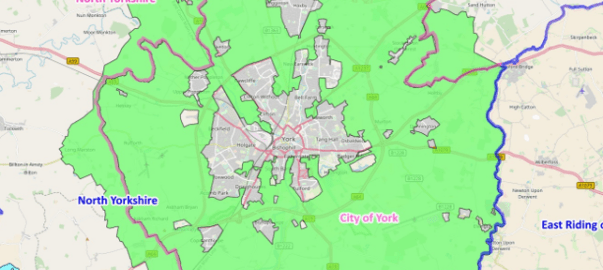
York’s (proposed) green belt…
Timothy Worstall of the Adam Smith Institute has commented on green belts:
“…the whole point of the green belt(s). [It’s] to stop any housing or other economic growth anywhere near where upper middle class people who make their living in our most important cities might want to live. That’s the whole point of it all.”
The value of building land increases by its scarcity. Green belts restrict the supply of building land, increasing its value. A plot of land big enough for a house costs less than £1000 at agricultural prices. In places like York this becomes worth nearly £200,000 when planning permission is granted. This “planning gain” accrues to the land owner.
These (greenbelt) restrictions are the major driver of the house price rises. These rises take from the poor and give to the affluent. The winners are landowners/developers and older established house owners. The losers are renters and newcomers to the housing market.
The value of planning gain could be diminished, if local authorities were able to buy enough land at agricultural prices and turn it into building land by granting planning permission. Such a policy has been blocked since the 1960s because of the requirement to pay much, much more than the agricultural price by paying “hope” value. There is a plan to change this. Inside Housing writes:
“Since the 1960s, local authorities have been required to pay hope value when making compulsory purchase orders (CPO). This obliges local authorities to pay the value of what land could be worth if it obtains planning permission at any point in the future – even if the landowner has no plans to do this.”
On the Labour Party’s manifesto, Duckworth Planning and Design report a promise to abolish the “hope value” element in compulsory purchase orders.
If Labour does abolish hope value, councils could buy land at not much more than agricultural prices, give planning permission for housing development, then sell it to developers (or individuals) at a large profit. In the case of the developments in the draft York local plan this could bring the council well over a £billion or about a decade of all council tax payments.
One question is: Why not?
Why not? – Because house prices should be reduced.
If York Council were to capture the £billion or so in planning gain inherent in the draft York Local Plan, it would not make housing less expensive.
However, it could make housing much less expensive by buying land by compulsory purchase at £1,000 or so per building plot, prepare the site, install basic services and sell them on for self build at, say, £10,000 each. This would still make a significant profit. (Note: In recent years such self-build plots have been sold by York Council at about £100,000 each. Effectively , that’s selling planning permission.)
Self builds under government legislation, can also be “custom builds”, so those that buy a plot can commission others to do the actual building. Could this include buying a modern version of the post war prefab? These are available at under £40,000 (e.g. the Kaya 4 wooden house) so a two bedroomed house on its own plot could cost under £50,000.
With government organisation of the housing market, as happened with the post-war prefabs, decent housing could be available at a fraction of today’s prices. ( RightMove reports: “House prices in York have an overall average of £334,806 over the last year. “)
The need for post-war prefab homes was driven by the need for emergency housing after the destruction during WW2. Support comes for a similar approach for today’s housing crisis – surprisingly from the Daily Telegraph: Bring back the prefab: they are the solution to Britain’s housing crisis.
Housing types aside, a key driver of policy should be reducing the enormous planning gain that accrues to land owners and developers when planning permission is granted
Climate change
In January 2021, UKʼs Climate Change Committee gave an Independent Assessment of UK Climate Risk, where it noted “low likelihood, high impact events”. The first was the failure of the Atlantic Meridian Overturning Current (AMOC). The AMOC brings enormous quantities of heat from the world’s southern oceans to warm the North Atlantic. A collapse of the AMOC would be devastate UK agriculture. (See Global and European climate impacts of a slowdown of the AMOC in a high resolution GCM and Climate change impacts on ocean circulation relevant to the UK and Ireland.)
Recently a group of climate scientists have come to the conclusion that a collapse of AMOC in this century has been underestimated. While this collapse was once considered “low probability,” the likelihood of it happening is increasing. In fact, it’s becoming so worrying to oceanographers that 44 of them, from various countries, wrote and published a call to action, warning that the risk of the AMOC reaching a disastrous tipping point is “greatly underestimated” and will have “devastating and irreversible impacts.” (See 44 Scientists Just Warned Us About a Catastrophic Ocean Current Collapse.)
… so AMOC collapse is no longer a low likelihood event.
Another of the Climate Change Committeeʼs “low likelihood events” is “Changes to the Jet Stream due to Arctic warming, leading to changes to UK weather patterns.” Research continues into the nature of changes to the jet stream but there is no doubt that weather patterns are becoming less predictable and more severe. For example, recent floods in Spain and recent wet weather in the UK, have affected food production. Mailport reports that “the 2024 potato harvest in the UK is shaping up to be one of the most challenging in recent memory” and:
Unpredictable weather has been a recurring theme, with both droughts and excessive rainfall affecting yields and quality. In 2020, for example, dry conditions led to lower yields, while 2024ʼs wet conditions have disrupted harvesting and increased risks of rot.
Recent evidence has increased the likelihood of changes to UK weather patterns.. The UK CCC noted changes in weather patterns will cause “widespread and large reductions in arable farming output”, undermining UK’s food security – as does the recent “rain in Spain”: Much of UK’s fresh produce comes from Spain.
There are also geopolitical dangers that may affect our lives in the UK. These possibilities, including more wars, is be outside the scope of a discussion on housing policy but the world, the “western” world at least, is becoming increasingly isolationist. “More isolationist” means we become more local., with less dependence on international trade. Consumption in the UK should be generated by more production in the UK. This should be reflected in York’s economy, with an increased emphasis on local food production – which also generates local employment.
Greenhouse emissions in York
1. In York, the website carbon.place gives personal carbon emissions in high emitting areas to be 4 times those in low emitting areas. This is in line with other evidence showing carbon emissions are strongly correlated with affluence. (See the JRF publication Distribution of Carbon Emissions in the UK: Implications for Domestic Energy Policy.)
2. The York local plan has several proposed developments which will provide housing for high emitting, – affluent two car households. e.g. Langwith, Elvington Airfield, which (oddly) is billed as “ a garden village” and “a more sustainable development”.
3. The “remaining carbon budget” is “the net amount of carbon dioxide (CO2) humans can still emit while keeping global warming below a given limit with a given probability, taking into account the effect of other anthropogenic climate forcers ”. (See Assessing the size and uncertainty of remaining carbon budgets, Nature Climate Change13, 1360–1367)
Affluent areas in York will exhaust the 1.5C budget in two years and exhaust the 2C budget in less than 10 years.
4. The climate disaster is approaching. To reduce carbon emissions sufficiently, the following must be cut:
- Car driving. The House of Commons Science and Technology Committee noted “In the long-term, widespread personal vehicle ownership does not appear to be compatible with significant decarbonisation.”
- Flying. Hansard (2 May 2007) recorded that “emissions from flights departing the UK contributed approximately 13 per cent. of total UK emissions in 2005 when the radiative forcing index is used.” The radiative forcing index increases the impact of CO2 alone because of other climate effects of flying.
- High carbon foods (beef, lamb, cheese).
- Carbon emissions from buildings – in construction and in use.
The UK has a stated aim of reaching net-zero greenhouse emissions by 2050. The Climate Change Committee notes that even the intermediate step of 68% reductions by 2030 will be difficult.
If the UK finds it difficult to reach a reduction of 68% by 2030, York’s aim of a 100% reduction by then is impossible, yet that is still York’s stated aim. Bizarrely, this is repeated before every full council meeting. This is delusional, especially as the draft local plan outlines new settlements that will have high carbon lifestyles.
P.S. Note on PassivHaus standards.
York Council’s Housing Delivery Programme says “The mixed-tenure homes will be built to certified Passivhaus standard and the development overall is designed to be net zero carbon in use.”
The term “in use” is telling because the PassivHaus Standard says nothing about the greenhouse emission caused by construction. A real concern for the climate count emissions due to construction. As electricity heads towards zero-carbon the extra emissions from constructing to PassivHaus standards become an important issue.
 Don't look now