202508_19aug_BBC_BuildingSoul
Building Soul on Radio 4
Listening to Building Soul on Radio 4 has given me some depressing deja vu – I’d heard similar stuff when I worked at Leeds School of Architecture for most of the 1970s. The presenter, Thomas Heatherwick started the programme with
“There’s been an epidemic of inhuman building plaguing or cities stripping them of character, joy and soul. I call it the blandemic.”
Heatherwick criticised today’s buildings for their box shapes and ubiquitous flat surfaces of Modern Movement Architecture with its rejection of ornament.
Research Findings: Architects trained to like buildings we don’t like?
In the first series of Building Soul, Hetherwick blamed the blandemic on architects’ concentration on the formal aspects of building. He cited research by Anjan Chatterjee and Alex Coburn. This analysed public reaction to the look of buildings into three principal characteristics, coherence, fascination and hominess. These can be proxied by simplicity of form, ornament and homeliness.
Chatterjee, Coburn and Hethwerwick argue that architects have concentrated on simplicity of form using shapes which make the overall look of a building clean and simple. That has led to the repetition of simple geometric entities like rectangles and flat planes, minimising ornament, ornament which mimics the complexity of scenes in nature that we have evolved with – and evolved to like.
So have architects been trained to like buildings that we don’t? It seems those that followed the Modern Movement have.
Modern Movement Architecture
Avoiding the informational richness like that found in the natural world was a core aim of the Modern Movement in Architecture. Their slogans were “Form follows function,” “Ornament is a crime,” and “A house is a machine to live in”.
Hetherwick placed much of the blame for the blandemic on the architect, Corbusier, who promoted building style of towers, slabs and podiums in the air – and traffic on the ground. (See also my section Tower Blocks and Roads in Housing – part 15: Five planning policies.)
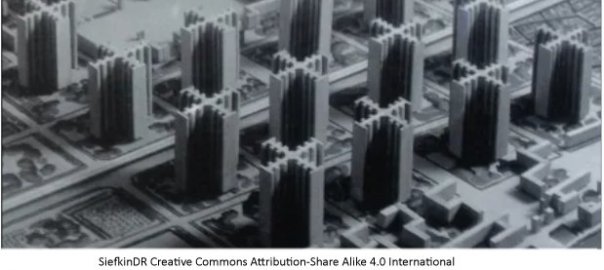
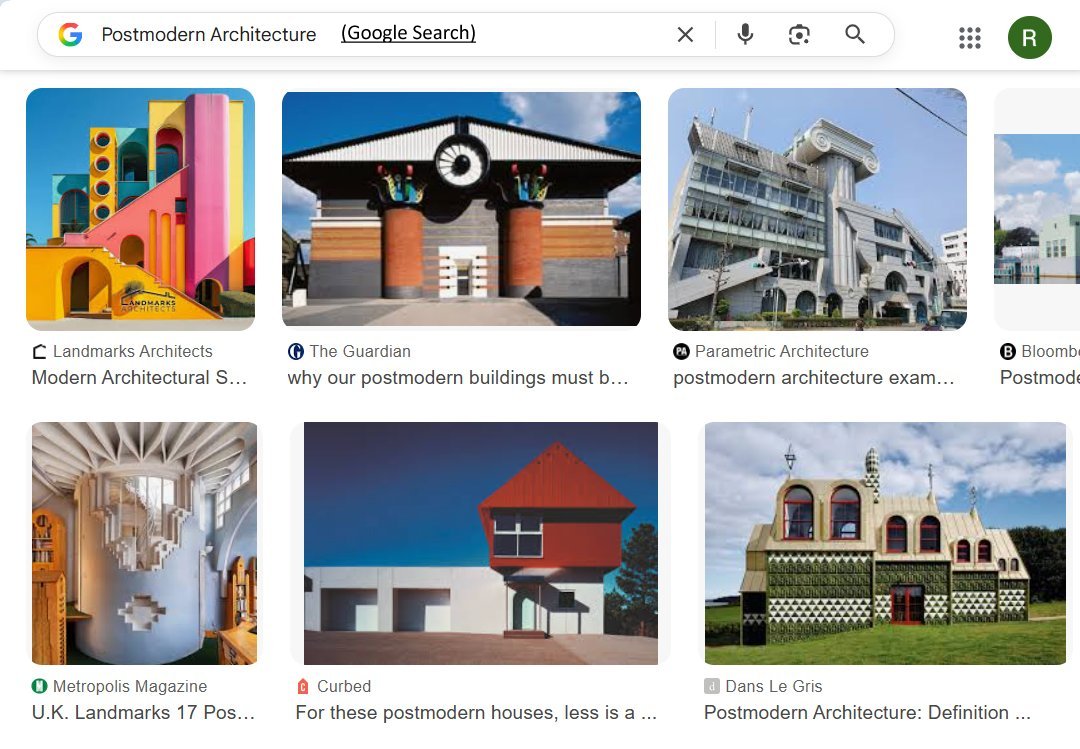
Corbusier’s buildings, like others of the Modern Movement, were not colourful. They were usually shades of white. When I was at Leeds School of Architecture in the 1970s, Corbusier was king and it was unknown for the architecture students to produce colourful plans or drawings of their designs. I remember the shock of wandering into a roomful of designs by landscape architect students and being overwhelmed by the colour. It is possible to have a similar experience using the Google search engine. Show the images for “Modern Movement Architecture” and compare with the images for “Postmodern Architecture”.
Modern Movement Architecture

Postmodern Architecture
Edgewood mews
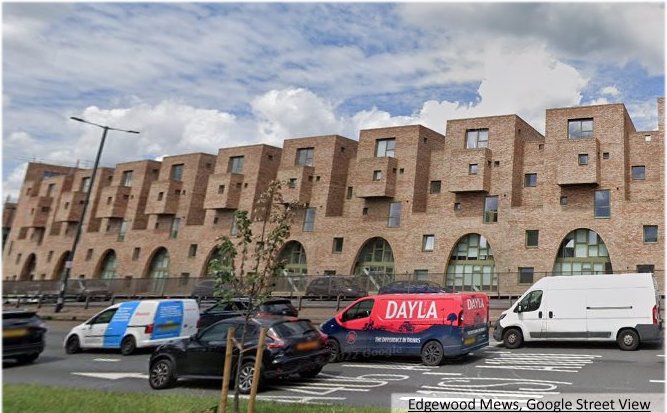
Hetherwick looked to modern examples to counteract what he calls the blandemic. He praised architect Peter Barber for his housing scheme, Edgewood Mews, on the North Circular Road in Finchley, as breaking with the blandemic. He says
“You actually have to go back and stop and have a look. [Such schemes] are so good and not just for the people that live there.” Kevin McCloud of Channel 4’s Grand Designs added “Exactly. It’s though it arrived from another planet as a gift to humanity.”
Edgewood Mews avoids the flat boxes of the Modern Movement. Hetherwick says “It’s outline moves up and down in a way that is dramatic and interesting but as you get closer you see that the outline is not boxy minimum but rounded with unusual roofs.”
However, the form of Edgewood Mews does have geometric regularity (and simplicity of form?): It’s regular protrudences along its facade give it the look of the gears of a massive well-oiled machine. It’s not ornament. It’s a richer form of geometric shape. OK, that’s still a score against the blandemic of rectangular box shapes but the shape of Edgewood Mews contains little ornament, although the pedestrian street that runs through it contains regularly spaced small trees in tubs .
More importantly how does Edgewood Mews score on aspects other than its effect as a building sized sculpture?
Oskar Newman
This brings me to the visit to Leeds of Oskar Newman, of Defensible Space fame. I asked him how student architects should go about designing housing. I expected a considered answer about “natural surveillance” that was the core of his work. His reply surprised me. It was simply to go out and find housing that worked and try and design something 5% better.
Well does Edgewood Mews work? It may look interesting to the motorists driving by on the North Circular but to really work, it must be environmentally sound, be affordable and should perhaps enhance neighbourliness and community. It should help its residents live happier lives.
Climate impact of building
In the introduction to the Building Soul, Hetherwick had noted the environmental impact of the building industry: Their “impact on our planet is immense. Cement is causing 8% of all human climate change emissions”. How does Edgewood Mews score on environmental criteria?
According to the Potsdam Institute for Climate Impact Research we have a remaining carbon budget for each of the world’s 8.2 billion people that is just 112 tonnes of greenhouse gases to keep global warming below 2.0°C. This budget becomes a tiny 20 tonnes if we aim for the 1.5°C target that is the aim of the Paris Agreement. How do these budgets compare with the emissions from constructing a 2 bed apartment in Edgewood Mews?
For brick based construction, like Edgewood Mews, Google’s AI overview says greenhouse emissions for a typical UK house are estimated around 80 tonnes of CO2e – and for an underground car park (as in Edgewood Mews) add 14 tonnes CO2e. For an average family size of 2.4 people this works out at 39 tonnes CO2e per person, nearly twice the remaining carbon budget to aim for the Paris Target. If these figures are anywhere near accurate, the construction of Edgewood Mews smashes the “Paris budget” even before the emissions of everyday life are considered.
Climate impact of residents
In use, the home based emissions of Edgewood Mews are probably below the average. They use underfloor electric heating and the apartments have a good energy rating (EPC B). Also UK electricity supply is aimed to be net-zero emissions by 2035. Powering these dwellings will likely cause less than a tonne CO2e per dwelling per year.
However, those residents in apartments not designated as “affordable housing” will be in the upper income range because low-income people are just not able to afford able to afford the £600,000+ price tag for an Edgewood Mews apartment. Research funded by the Joseph Rowntree Foundation has shown that the richest 10% produce over 3 times the greenhouse emissions as the poorest 10% of the population. Half the apartments are for “affordable housing” but that needs a couple’s combined income to be less than £90,000. That suggests that even these apartments will contain relatively well off residents.
Google AI says “For an average UK family of 2.3–2.4 people, the annual consumption emissions are estimated to be between 26 and 28 tonnes of CO2 equivalent”. The residents of Edgeware Mews may fare a bit better on home power but there is an underground car parking space for each resident. They are likely to be motorists. Like most of the UK these resident will eat meat and many will take at least one flight a year. Their consumption emissions will approach 10 tonnes CO2e per year, a bit less than the UK average.
According to the RIBA Journal Edgewood Mews does have installed solar energy which peaks at 102.12 kW. That should produce nearly 900kWh per apartment each year, about half of the electrical energy consumption of a typical UK 2 bed apartment. Despite this I can’t see how Edgewood Mews fits any sensible climate targets, especially when emissions from its construction are considered.
Community spirit
The claim that Edgewood Mews will have good community spirit may have some merit but I remember, in 1976, Geoffrey Darke (or was it John Darbourne?) coming to Leeds to claim the same about Darbourne and Darke’s Marquess Estate in Islington. AI overview describes says:
The Marquess Estate in Islington features low-rise, community-friendly architecture with connecting “roof streets” and underground car parking.
He claimed that the roof streets would would generate neighbourliness and community. Now, however, the “estate has unfortunately seen significant vandalism, with reports of damage to play areas and other communal spaces”. I expect Edgewood Mews will generate a much better sense of community than the Marquis Estate but that pudding is still for the eating.
Research by Professor Carmona of UCL has shown that most people want to have a garden. That’s not a criticism of Edgewood Mews. Residents that choose to live there will have made the choice that a garden isn’t essential. However it does show that high density apartments are not a universal solution.
Cost of Edgewood Mews
I haven’t found any estimates of the cost of building Edgewood Mews. The article in the RIBA Journal says the construction cost is confidential. It is clearly an intricate design needing skill and care in the construction but with selling prices of over £600,000 per apartment construction costs may be a large proportion of this. Made possible because the land was community owned.
Summary
Edgewood Mews avoids the rigid style of boxes and flat planes of the worst of the Modern Movement but its attraction to architects stems from its geometric coherence. (One comment on redit says “I get that I should like it, and my brother – an architect – keeps singing its praises, but …”)
Its construction alone breaks carbon budgets. It (almost certainly) had high construction costs. It may promote neighbourliness. It is for residents that don’t want the gardens that most people want.
Compare this to the success of the post war prefabs.
Finally, be sceptical of the aesthetic judgements of architects. Many of them have been trained to like the designs of the Modern Movement. This makes them different from punters like us.
Postscript
To overcome the problem of the embodied carbon in buildings with rich geometric form like Edgewood Mews, wood can be used to replace most brickwork. For example, Blokbuild have developed a system that uses custom manufactured components which can be assembled to make geometric form. The manufactured components, which Blokbuild call cassettes are the “bricks” of their system.

In Building Britain’s Biggest EVER Bolt-Together Timber Home, Channel 4’s Grand Designs has featured a three storey house in Acomb York made to this system.
 Don't look now