This note proposes the construction of sufficient prefabricated homes to meet UK housing need. They would be sited near existing settlements or transportation routes. The proposal downplays the role of new towns, which take too long to build and will cause high carbon emissions in their construction.
Park Homes
Park homes are one form of prefabricated home delivered to site by specialist transport companies on modified lorries. They are mostly put on specially designed sites, referred to as parks. They are single storey. A typical park home has roughly the same floor area as a new 2 bedroomed house of traditional construction. Park homes are a tried and tested form of prefabricated homes, with over 100,000 park homes in the UK.
I append the six parts of my emails “Bring back the prefab” as a PDF. These were the result of using various AI chatbots. Here is a summary:
Part 1 told how the post-war prefabs were socially successful. They were designed with people in mind: one-storey homes with green space and private gardens. “Compared to later tower blocks or cramped terraced housing, prefabs gave people space and light, creating a more relaxed environment for community life”.
Part 2 pointed out that the construction of modern wooden prefabs caused a fraction of the emissions of greenhouse gases compared to houses built in a traditional fashion. It also pointed out that prefab construction is much cheaper.
Part 3 concerned neighbourliness, which was high for the socially uniform populations of prefab and council house estates. The social fabric of council housing rapidly worsened in the 1980s driven by policy changes & economic shifts.
This led to a policy of mixed-income developments, where social housing for low income residents was mixed with private housing for more affluent residents. Critics argued that it could be seen as a form of “soft” social engineering—a way to manage or disperse poverty without addressing its root causes.
Mixing low income housing with market priced housing, means mixing high car ownership residents with low car ownership ones.
Part 4 concluded that out of town developments that provide one, two (or even three) car parking spaces are not suitable for lower-income people with limited car use. Such developments also have very high carbon emissions.
Part 5 concluded that new towns are not an answer. They take decades to build, and have high embodied carbon. Estates of car-free modern (mostly wooden) prefabs (with solar roofs, heat pumps &tc) are a good start. They should be placed next to existing settlements to provide low carbon services for them.
Part 6 noted that a plot of agricultural land big enough for a house is valued at less than £1000 – but when planning permission is granted its value leaps to between £100,000 to £150,000 so a large part of the cost of a new house is created by planning permission. This accrues to the land owner. For a £300,000 house on the fringe of York, Copilot has estimated:
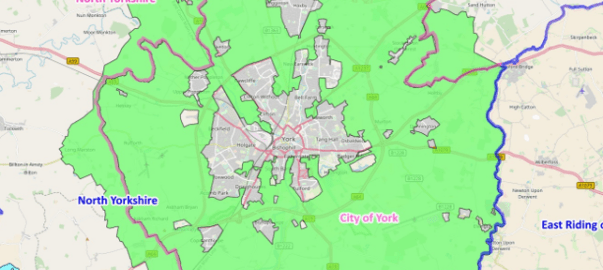
The new York Local Plan plans housing for affluent people who live similar lifestyles to existing settlements, where their carbon footprints have been calculated to be very high. These are suburban places near York’s Outer Ring Road with high car ownership. Thanks to the team behing the website carbon.place for doing the calculations. The site estimates that residents in these areas of York have carbon emissions upto five times those in the areas where residents’ emissions are the lowest.
High car ownership is an indicator of affluence, which is an indicator of high carbon emissions. For the affluent residents their emissions from flying are often higher than their emissions from driving their cars. The UK Government is claiming that in the next few decades emissions from aviation will reduce as and increasing amount of “sustainable aviation fuel” is used to power aviation.
Timothy Worstall of the Adam Smith Institute has commented on green belts:
“…the whole point of the green belt(s). [It’s] to stop any housing or other economic growth anywhere near where upper middle class people who make their living in our most important cities might want to live. That’s the whole point of it all.”
Links to my notes from then are at the end of this post
Cost of housing in York
A new house in York costs almost £200K more than a similar one in Middlesbrough.
A plot of land in the York area big enough for a house costs less than £1K at agricultural prices. It becomes worth the best part of £200K when planning permission for a house is granted.
House price rises in York have risen 70% over the past 20 years. That’s roughly the same as UK inflation (mean 2.7% a year). However houseowners, who took out mortgages will have benefited in real terms because the value of this debt will have decreased in real terms by 40%.
Housing affordability estimates are calculated by dividing house prices by average annual earnings to create a ratio, The “affordability ratio”. It was 6.22 in 2003 rising to 8.8 in 2023 – but was 3.71 in 1997. A large increase occurred in 2001 to 2003.


 Don't look now