Could James Hansen’s super storms overwhelm the sea defences around nuclear power stations? (http://ow.ly/ZXYLP )
Category Archives: Uncategorized

Correcting for more than just el Niño
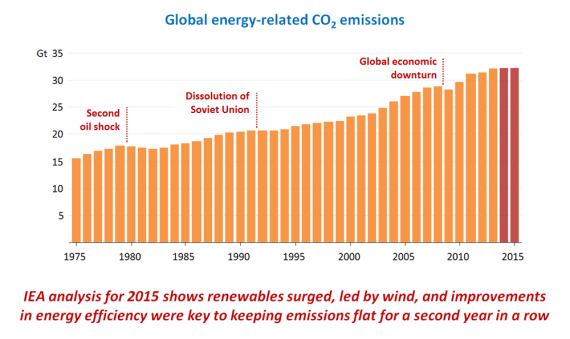
Tamino’s Open Minds (reblogged below) shows below shows that even without el Niño 2015 was the hottest year on record – but first the Inernational Energy Agency: IEA Confirms Decoupling Of Global Emissions & Economic Growth
They say:
For many years it was assumed that global emissions and economic growth were tied together in an unbreakable knot, however, recent years have seen signs indicating this may not necessarily be the case. According to analysis of preliminary data for 2015 released this week by the International Energy Agency (IEA), global energy related carbon dioxide emissions stayed flat for the second year in a row, while economic growth continues.
However, the US National Oceanic and Atmospheric Administration reported an unprecedented spike in atmospheric carbon dioxide levels in 2015.
The IEA reports emissions down, NOAA reports CO2 concentrations are up. Strange.
Climate Central gives an explanation from Michael Mann, one of the best known climate scientists:
“This spike is almost certainly due in substantial part to the ongoing El Niño event, which is a fleeting effect that increases carbon dioxide concentrations temporarily,” Mann said. “Carbon dioxide concentrations are a lagging indicator, and they don’t accurately reflect recent trends in the more important variable — our actual carbon emissions.”
But why are CO2 concentrations a lagging indicator?
Is it because of temperature/CO2 feedback or some other effect? If it’s temperature driven feedback what are the mechanisms? Are they feedback mechanisms that are accounted for by the climate models?
How accurate are the IEA’s emission figures?
Note: There will be a postscript – possibly with some answers
But here is another excellent piece from Tamino …
I recently showed a version of “el Niño-Corrected” temperature from Gavin Schmidt at NASA. My own calculation suggested that el Niño caused about the same contribution to 2015’s heat as Gavin’s estimate. However, there are some pronounced differences between our calculations.
View original post 475 more words
Sadiq’s housing policies
Sadiq Khan’s housing policies may be strong
but they are not strong enough.
This piece follows a very moving article on Left Foot Forward…

The article is excellent but below is a response to this sentence …
“Thankfully, Labour’s London mayoral candidate Sadiq Khan is tackling this issue head on with a whole suite of policies to enable the u-turn on housing that is needed, so that ordinary Londoners, vulnerable Londoners, every Londoner can access the basics: food, water, shelter.”
My response…
Are Sadiq’s policies radical enough? Isn’t it true that
1) It is possible to create homes for about £20,000 if the land is provided just a bit more than agricultural prices (i.e. £1,000 per housing plot). Then cheap a starter homes can be delivered to the plots. (See https://t.co/Wr080mdSaL ) Unlike Sadiq’s policies, a properly planned plotland development could happen very quickly.
2) We are facing a real climate disaster. Traditional bricks and mortar houses (as shown in Sadiq’s “Homes for Londoners”) have such large embodied carbon that they swamp personal carbon budgets and help screw the climate. (See https://t.co/dGld1fiPUo )
P.S. The affluent cause much more carbon pollution than the poor. We should be taxing the affluent, the polluters, and giving to the poor, who pollute less.
P.P.S Why do most on the left push economic growth, which the climate can’t afford (http://ow.ly/ZuMI1 ) rather than redistribution. We don’t need to ruin the Earth just to give to the poor.
London Housing Commission misses bigger pictures
The London Housing Commission have just produced a report Building a new deal for London. They should be supported in its aim “to identify sufficient land to deliver at least 50,000 homes per year for the next decade”. This 500,000 homes may be a reasonable target.
The commission also identifies problems with planning permission: “There are too few new planning permissions” and speed of delivery could be increased on sites where planning permission has been granted. Their suggestion to allow the boroughs to levy developers who have failed to meet agreed building targets may be helpful. However, they may be missing bigger pictures.
First, at 51.3 people per hectare, London is over ten times as dense as the rest of the South East Region. There is plenty of land outside London with served by railway lines. Room for a population the size of London by taking only 10% of land in the South East Region. Continue reading London Housing Commission misses bigger pictures
Don’t nuke Brazil
This is a reply to Dan Miller’s comment on RealClimate.org
Dan Miller #50
EXCELLENT BUT OPTIMISTIC
Your comments are excellent and your TEDx talk is very excellent. I shall do my best to get others to watch it.
However (as Mona Lisa Vito said in My cousin Vinny), you are too optimistic to claim that “Fee and Dividend” alone can “fix climate change”. I guess that your talk was fashioned for the political scene in the USA and you may be restrained by political reality. These constraints should not hold in discussions here.
THE TIMESCALE IS TOO SLOW
Your timescale for cutting emissions is too slow. Let us assume a new US government will introduce a Fee&Dividend like you describe by the autumn of 2017 and CO2 emissions are initially charged at 1¢ per Kg and rising to 10¢ per Kg in ten years. Can this cut emissions fast enough?
Carbon Brief did their calculation “Six years worth of current emissions would blow the carbon budget for 1.5 degrees” in autumn 2014. By now it will be “Three years current emissions”. To keep below 2°C there seems to be 20 years or so but with the “lack of feedbacks” – that you mention – means it is difficult to get reliable estimates. Continue reading Don’t nuke Brazil
Green belts and corporate land banks
In his papers, “The Homes London Needs: Part 1 & Part 2“, Chris Walker of Policy Exchange assumes that building on the green belt is politically impossible. I think that in the public mind “green belt” may mean any land within 100 miles of Central London. This leaves brownfield development and densification as the only solutions.
BROWNFIELD AND GREEN URBAN PARKS
Brownfield sites are more expensive to develop both in money and environmental terms. They would better be converted into green urban parks such as happened at St Nicholas Fields in York. The Barker Review of Housing Supply (2004), reported that urban parks were valued 60 times as much as urban fringe green belt by the public. (Table 2.1: Benefits from different land use)
DENSIFICATION AND EMBODIED CARBON
If densification means higher buildings then embodied carbon should be considered. This measures the greenhouse gasses due to construction. High buildings usually have enormous embodied carbon pushing climate further to the danger zone.
THE CORPORATE LAND BANKS
Prototype sustainable neighbourhoods
Low cost, sustainable housing in California
A comment on
“A multi-dimensional approach to affordable housing policy:
Learning from climate change policy”
by Professor Karen Chapple
See also Berkeley zero net energy cottage deserves study
A sustainable backyard cottage
This article gives me a glimmer of hope. It shows that low-cost, environmentally sustainable homes might be built and get through zoning regulation. (Is “zoning regulation” the correct term for what we call planning permission in the UK?). I like the look of Professor Chapple’s backyard cottage but hope the $98,000 could be reduced production volumes were higher – there was a piece in the UK press reporting a family in Arkansas moving into a $20,000 “shotgun shack” with satisfactory results.
What price level could actually be achieved for a tiny home with a very low carbon footprint?
Embodied carbon
Measurement of the carbon emissions from the buildings, when in use, is not the only consideration: Measurement should also include embodied carbon – based on the greenhouse emissions from constructing the buildings (including the embodied carbon in solar panels & etc.) Embodied carbon is usually ignored. Continue reading Prototype sustainable neighbourhoods
Tax credits tame the self employed
No warning for the claimants
HMRC Targets for low paid self employed are very worrying as the tests are likely toeliminate many self employed Tax Credit claimants, whose earnings are below the Minimum Income Floor of £12000. Over a third of self employed claimants’ earnings are below this level and will be subject to demands for information from the HMRC which is intrusive and unnecessary.
There was little consultation before the legislation was passed.
Alison Ward of the Association of Tax Technicians (ATT) says some concerns were raised about this when HMRC held a teleconference with members of the Benefits & Credits Consultation Group (BCCG) last March. See : Strengthening the self-employment test for working tax credit in Tax Adviser Magazine. Alison Ward says
In summary, our concerns were as follows:
The lack of publicity surrounding the change to forewarn claimants;
The very short timescale in which to make the finalised guidance available;
The lack of time in which to appropriately train HMRC Tax Credits staff who are going to be taking on the role of key decision makers when reviewing whether an individual is trading commercially, with a view to realising a profit;
The number of claimants who will not have the necessary evidence, such as business plans, with which to prove to HMRC that they are trading commercially; and Continue reading Tax credits tame the self employed
£slavestretcher

There are some businesses that thrive on poverty, and Poundstretcher is one of them. Poor people shop there because it is cheap – and one reason it can be so cheap is that people are forced to work there for free or lose their benefits, under the DWP’s Mandatory Work Activity scheme: probably some of the same people who they rely on as customers.

Last week one of our SUWN activists was told to report to Poundstretcher in Dundee this morning, along with a group of around 8 other people on JSA. He was not happy, and yesterday he delivered a letter to Learndirect who arranged the placement. This made clear that it was not reasonable, even in their own terms, to expect a skilled IT engineer who had been unemployed only 9 weeks to do a placement designed to ‘develop disciplines associated with employment’. It also pointed out that…
View original post 346 more words
How The Joseph Rowntree Foundation Stopped Worrying And Learned To Love The Tory Party

 Yesterday the Joseph Rowntree Foundation, who claim to be an anti-poverty think tank, held their annual lecture. Coming at a time of soaring homelessness, brutal benefit sanctions and more cuts on the way you might have expected this event to discuss how to best resist, or at least mitigate the impact of what is to come.
You might have expected that. What happened instead was a speech by the leader of the Scottish Conservative and Unionist Party Ruth Davidson during which she set her stall out as a Tory who pretends to care about the poor in advance of the Scottish parliament elections in May. She was warmly received by the small gathering of poverty professionals who bothered to turn out for the lecture. She should have been fucking lynched.
Davidson began her speech with a frank description of how most in the Conservative Party view the poor – in…
View original post 771 more words
Can we keep under 2°C without reducing consumption? And 1.5°C?

I took Carbon Brief’s “Six years worth of current emissions would blow the carbon budget for 1.5 degrees” seriously and used it in “Is Green Growth a Fantasy”. This estimates the rate of decarbonisation of world GDP necessary to keep within 2 degrees.
The argument relies on reducing and restricting carbon emissions until the time when the world can balances carbon emissions with carbon sequestration.
According to quite straightforward (but rather optimistic) calculations, the world can reach 2050, without exceeding the 2°C limit by cutting the carbon intensity of production by 3.7% a year. This is assuming the average world citizen’s consumption remains the same. See “Optimism and pessimism on climate”.
However, the 3.7% decarbonisation in 2015 seems a fluke maximum (as Carbon Brief reported in “Decrease in China’s coal use sees global emissions fall in 2015”). The average decarbonisation for the past 25 years has been 1.3%.
Worryingly, Carbon Brief’s has a video of Michael Jacobs. He says 2080 is the date for BECCS to work. That’s long after the 2050 date I had assumed. That would mean global GWP per person must fall – even if it were possible to keep up the improbable rate of decarbonisation of 3.7% . Will this be politically possible?
Is it really possible to keep temperature to below 2°C without falling consumption?
And the COP21 aim of 1.5°C. Is that just fantasy, just like “Green Growth”?
The Committee on Climate Change should tell the whole truth.

“Lord Deben, Chair of the CCC” by mintyboy on Flickr.
Licensed under CC BY 2.0 via Commons.
The Committee on Climate Change (CCC) has just published its proposal under the climate change Act for the UK carbon budget for 2028 to 2032. It is 175 million tonnes CO2e for the 2028 to 2032.
Last year following a piece by Carbon Brief, I took the IPCC’s remaining carbon budget for a 2°C rise in global temperature. (We are just passing the 1°C mark.) I divided this remaining budget by the number of people in the world to get a world budget per person. This gave 115 tonnes of CO2e per world citizen.
The CCC’s budgets from 2015 to 2032 amount to 7,650 million tonnes of CO2e. That is 118 tonnes CO2e per UK citizen. This exceeds the world personal budget of 115 tonnes already.
HOWEVER (as Mona Lisa Vito says in My Cousin Vinny), our government budgets are false budgets because the UK carbon budget is measured on a production basis (i.e. They only count CO2 emissions from what is produced in the UK). The budget does not include the embodied carbon in imports. This leads to the nonsense that closing UK steelworks lowers UK emissions, while actually increasing our real emissions. We should probably double the figure for official emissions for this reason and some others like the underestimation of methane’s power. Worse still, the IPCC budgets are too liberal because their models had missing feedbacks.
Perhaps the rest of the world will help us out and stop driving cars, eating beef and building with steel and concrete.
The Committee on Climate Change should really tell the whole truth – and loudly.
But, as I have heard their Lord Deben say, there are political limits to what can be achieved
– and the Friends of the Earth described him as “the best Environment Secretary we’ve ever had”.
Working Full Time And Think You’re Safe From The Jobcentre? Not If The DWP Get Their Way.
“[DWP study] is about manufacturing evidence, not any real attempt to find out if this is something people actually want or need”
“Instead the Tories imagine a UK PLC – some kind of giant version of The Apprentice, full of selfish grasping wankers, ruthlessly fucking each other over until the second we retire – if we get to retire at all. “
 Are you striving hard enough? The nudge unit is watching you.
A study released by the DWP today shows that tens of thousands of Tax Credits claimants – some of them with full time jobs – have received letters and texts encouraging them to contact government busy-bodies for advice on how to increase their earnings by finding a new job or gaining promotion.
This startling fact is contained in an evaluation of the ‘In-work progression advice trial’ quietly carried out in 2014. This pilot scheme, run by the DWP in conjunction with the shadowy Nudge Unit, involved 75,000 Tax Credit claimants receiving a letter encouraging them to contact the National Careers Service for advice on how to progress in work. Around half of participants also recieved a text message.
Claimants were chosen largely at random from those earning a monthly income of £330–£960, so those working full-time at the then…
View original post 788 more words
Did Angus Robertson svengali Mhairi Black’s maiden speech?

At the Fabian conference on Saturday, I heard Jeremy Corbyn say we must reach out to left wing parties in Europe. I wondered if that included the Scottish Nationalists because in one Labour committee room I visited on election day last year, four out of four of us said we would have voted for the SNP, had we been in Scotland. We might not have actually gone that far but we were obviously affected by the reputation of the SNP becoming a caring left-wing party while Scottish Labour had a Blairite reputation (Should that be Mandelite?)
Since then, like many others, I have seen Mhairi Black’s maiden speech as an MP. Emotionally brilliant with some home truths for Labour.
“I like many SNP members come from a traditional socialist Labour family and I have never been quiet in my assertion that I feel that it is the Labour party that left me, not the other way about.
The SNP did not triumph on a wave of nationalism; in fact nationalism has nothing to do with what’s happened in Scotland. We triumphed on a wave of hope, hope that there was something different, something better to the Thatcherite neo-liberal policies that are produced from this chamber. Hope that representatives genuinely could give a voice to those who don’t have one.”
Later I met someone from the Scottish Labour and asked if Mhairi could be the next leader of the Labour Party. Continue reading Did Angus Robertson svengali Mhairi Black’s maiden speech?
Capitalists are not all nice but…
I’ve given up on “Capitalism can cure climate change”
on Brussels Blog. This post includes some bits from that piece.
I know the gist of what I want to say: We must control capitalism and use its power to save the world from climate disaster. For those that care about people, that means giving everybody a share of the rewards from capital assets. I have written about this in Stop growth, redistribute wealth and try to save the planet and Amartya Sen on growth and climate.
Are capitalist psychopaths? Are big companies dangerous?
Interviewed by Forbes Magazine about his book, “The Psychopath Test: A Journey Through the Madness Industry”, Jon Ronson said
I think my book offers really good evidence that the way that capitalism is structured really is a physical manifestation of the brain anomaly known as psychopathy. However, I wouldn’t say every Fortune 500 chief is a psychopath. That would turn me into an ideologue and I abhor ideologues.
The minor capitalist and academic sitting next to me has just said “The bigger the capitalist, the worse they are”. Well, capitalist guru, Adam Smith, agreed. His ideas may have been captured by apologists for crony capitalism but he disliked the power and influence of large international companies.
Such companies, in Smith’s view, had corrupted and captured many European and non-European governments and undermined their societies’ ability to engage in peaceful transnational affairs and equitable self-rule.
Exactly.
Is capitalism innovative?
The New York Times have an interesting article, Why Can’t America Be Sweden?, on the work of Acemoglu, Robinson and Verdier. This says
Asked for examples of America’s leading role in innovative enterprise, Acemoglu listed: “Software (Google and Amazon), hardware and design (Apple), social networking (Facebook and Twitter), biotech, pharmaceuticals, robotics, nanotechnology, entertainment and retail (Wal-Mart).”
Like many others, I’m not very impressed – particularly on innovation in software. Many of the best known like Facebook, Skype and Visicalc (the first spreadsheet) were written by one or two people as a challenge – because they could do it. Innovative software rarely starts with big teams.
The success of America’s “innovative enterprise” is pushed along by the lawyers building war chests of patents and other intellectual property for corporations. It also helps to be in a large market with good access to capital and have corporations with marketing muscle and be in a country that can change the law on intellectual property to tax the whole world.
Big corporations must be put to work
Large scale capitalism may be run by psychopaths. Corporations may corrupt and capture governments as Adam Smith described. They may not be as good at innovation as they claim but now is not the time to destroy them – even if we could. Given the current climate crisis, governments may need root out corruption and undue influence but the top priority is to set the conditions for a transition to a low-carbon existence.
That means prototyping low-carbon lifestyles that the people of the world can accept. See A market in prototype neighbourhoods.
Big corporations have the power and scope, which would enable them to do this.
The obvious mechanism to incentivise these corporations is a very large carbon tax.
And if they require some innovation, they can give me a call.
Green growth and the limp left
Green growth and the limp left
Watching the sunset
Our modern, developed lifestyles pollute the planet. We fly planes, drive cars, eat beef and build with bricks, steel, concrete and tarmac. We are driving the planet to the end of life on Earth as we know it.
But what will happen if we cut consumption? (Note: Consumption is stuff we pay for. Watching a sunset out of the window isn’t consumption. Watching it in a cinema is.)
Consumption and jobs
Consumption is key to limp-left economics. It creates demand for production and production creates jobs. Cutting consumption, cuts production and destroys jobs. What do the limp left suggest for the poor, the wage-slaves, who depend on jobs for their income?
The limp left still argue for growth (mainly for jobs) and claim consumption can be decarbonised. They call their growth “green growth”. Unfortunately, we do not have time to replace polluting consumption by their green consumption. For now, green growth is a fantasy.
So what to do about jobs?
Tax, subsidise and redistribute
If we hold onto the idea that jobs are good for us as a society, we can subsidise them directly or we can subsidise incomes – as with in-work tax credits. If the subsidies are large enough as many jobs as necessary can be created, either by direct subsidy to the employer or by allowing workers to accept lower wages. Both policies support the standard of living of the poor.
How should subsidies be financed?
Tax the affluent polluters.
Message to the limp left: Get real! Stop growth and redistribute.
Message to the affluent: You are screwing the planet. Pay up.
References:
BBC’s silence on climate

“Pay no attention to the man behind the curtain”
Monday
The BBC are still dragging their feet on climate. On Monday morning the BBC World Service Newsday 6.06 GMT had a piece “Weather Wreaks Havoc in US and Britain”. Oddly the presenter says its 8.15 GMT at 8.30 into the recording then continues:
“Now there’s a number of extreme weather stories from right around the world some scientists are talking of the effect of the climate phenomenon known as El Nino where heated water unusually heated water in the pacific ocean ends up causing extreme weather patterns around the globe
In the southern United States more than 40 people are known to have died to the severe weather..
…parts of Latin America are seeing tremendous droughts and parts are seeing the worst flooding seen in 50 years.More than 150,000 people have been forced to evacuate their homes…In the UK
…highest river levels ever recorded in parts of Yorkshire…”
No mention of climate change.
Later Monday
The BBC, Kevin Anderson and missing climate feedbacks

Increased forest fires are missing from climate models.
I have just posted this here on Neven’s Arctic Forum…
I’m pleased that the most outspoken (=willing to tell the truth?) climate scientist in the UK, Kevin Andersen, has had some airtime on the BBC e.g. R4’s Today.
My first thought: Is the BBC changing from being a bunch of climate delayers?
Answer: Not sure: The Best of Today podcasts don’t include the item
— Speaking on the programme is … Kevin Anderson, professor of energy and climate change at Manchester University.
but they do include
— Will the US abolish the Confederate flag?
— Gay priest reacts to church ban
— ‘Huge rise’ in newborns taken into care
— Monday’s business with Simon Jack
Anyway kevinandersen.info says
The Paris Agreement: 10/10 for presentation; 4/10 for content. Shows promise …
The Paris Agreement is a fitting testament to how years of diligent and meticulous science has ultimately weathered relentless and well-funded attempts to undermine its legitimacy. Building on this science base and under the inspiring auspices of the French people, the global community has come together as never before to tackle what is arguably the first truly globalised and self-induced challenge to humanity.
However, whilst the 2°C and 1.5°C aspirations of the Paris Agreement are to be wholeheartedly welcomed, the thirty-one page edifice is premised on future technologies removing huge quantities of carbon dioxide from the atmosphere many decades from today. If such highly speculative ‘negative emission technologies’ prove to be unsuccessful then the 1.5°C target is simply not achievable. Moreover, there is only a slim chance of maintaining the global temperature rise to below 2°C.
Missing work on missing climate feedbacks
Continue reading The BBC, Kevin Anderson and missing climate feedbacks
Optimism and pessimism on climate
A little optimism on climate
The recent publication in Nature, Reaching peak emissions, by Jackson et. al., has been echoed by hopeful messages in the media. Carbon Brief is more measured. Their piece Decrease in China’s coal use sees global emissions fall in 2015 starts optimistically:
The rapid growth in global carbon dioxide emissions over the last decade appears to have stalled, a new study says. Early estimates suggest that global emissions will decrease by 0.6% this year, following a small increase of 0.6% in 2014.
But Carbon Brief also reports
The break in the emissions trend is mainly down to a drop in coal use in China, the study says, which drives a projected decrease in Chinese emissions of around 4% compared to 2014.
However, this is unlikely to signal a peak in global emissions just yet, the researchers say.
But I’m more pessimistic on climate
Brazil’s Great Amazon Rainforest Burns
Source: Brazil’s Great Amazon Rainforest Burns as Parched Megacities Fall Under Existential Threat
Note: Wildfires in the Amazon cause a climate feedback that is not accounted for in the computer models used for the IPCC’s predictions of climate change. The feedback from wildfires is only one of several missing feedbacks. Most of these reinforce climate change.
This means climate change in the real world will actually be worse than IPCC predictions.
Strangely, more feedbacks makes methane emissions from cows even worse. Do any policy makers that know this? Hilary Benn might. See Chatham House: Reduce meat and dairy to save climate
Reduce meat & dairy to the save climate
Robert McSweeny has written an excellent piece for Carbon Brief, Reducing meat and dairy a ‘win-win’ for climate and health. It concerns a recent report by Chatham House that makes these points:
- Reducing global meat consumption will be critical to keeping
global warming below the ‘danger level’ of two degrees Celsius. - Public awareness of the link between diet and climate change
is very low.
Carbon Brief quotes one of the authors, Laura Wellesley:
“The assumption that interventions like this are too politically sensitive and too practically difficult to implement is unjustified. Our focus groups pointed to a public that expect governments to lead, that expect governments to take action on issues that are in the public interest.”
But what will it take to get politicians to take the risk and act – or at least not deny? In the past, I have confronted politicians on this issue, with no response. When Hilary Benn was DEFRAs Secretary of State for DEFRA, I emailed him after meeting him
Is DEFRA considering any policies that might make substantial reductions in the impact of sheep and cows? And should the the government inform and consult public on this issue?
(See also Can DEFRA be trusted with the climate?)
My comment on Carbon Brief’s article (Key point: Even Chatham House underestimates the impact of meat and dairy.) …
This article is excellent stuff. Congratulations to Carbon Brief and Chatham House.
However…
“Globally, the livestock sector accounts for 15% of all greenhouse gas emissions – that’s equivalent to all exhaust emissions from every vehicle on the planet.” The source of the “15%” is Tackling Climate Change through Livestock by the FAO.
Without actually saying so, the FAO hint that the Global Warming Potential for methane used in their estimate was measured over 100 years. But we must eke out the remaining carbon budget until we can extract CO2 from the atmosphere.(See Is Green Growth a Fantasy?). The IPCC target for large scale carbon extraction is the second half of the century – 30 to 40 years from now).
Such a time frame means that the hundred years is an inappropriate measure for methane’s potency – a shorter time should be chosen. One of the standard ones is 20 years. This makes the impact of methane three to five times worse (depending on whose figures are chosen). Consequently, beef and lamb production are significantly worse.
There are estimates of the emissions from livestock from different sources: e.g. the Times, the FAO and the World Watch Institute. The WWI estimates are in “Livestock and Climate Change”, written by employees of the World Bank.
These are compared in “How long is livestock’s shadow?” which concludes…
“ …the Times says 9%, the UN FAO says 18% and the World Bank people say 51%.”
Yes, the WWI report does say the total greenhouse gas emissions attributable to livestock products are greater than 51% of the Annual emissions worldwide.
The WWI 51% uses the (more realistic?) 20 year period for estimating the Global Warming Potential of methane.
I would be interested to know why the World Bank did not publish their employees work. Is it because as you say …
“Governments have shied away from promoting sustainable diets in fear of a backlash from the public and food industry, while the lack of action means public awareness of the climate impact of meat and dairy is low.”
Cars: A waste of space
This was from the website
www.nocars.org.uk (now retired)
A waste of space
21st September, 2009 – 3 Comments
Climate change is the most urgent reason for drastically reducing motoring but there are many others. Top of the list is the space they waste. Here’s a blast from 1973:
The problem is that of designing an environment for people, who occupy a few square feet and need tens of square feet to move, which can also accommodate a large number of motor cars, which occupy hundreds of square feet and need thousands of square feet to move. This has consequences for housing design and for urban form. There are also other characteristics of motor cars which damage the local environment so that a large number of them in an urban setting has the effect of encouraging people to spread out spatially in trying to avoid the nuisances of heavy traffic.
Put simply, the choice is between compact no-car Venice and sprawling all-car Los Angeles.
Which do you choose?
3 Comments
James, January 5th, 2011 at 11:40 pm
Thats easy, I choose Venice
luke, May 23rd, 2011 at 1:08 pm
I’m more of an LA man myself
Geoff Beacon, March 14th, 2013 at 7:04 pm
Excellent video on Car Free Venice: http://vimeo.com/channels/carfree
Courage in Congress
My first reblog.
This would make an stirring speech.
Can it be recorded – with background images?
It’s hard to believe. But it can happen.
And it did happen. Not from Lamar Smith, who is on a rabid witch-hunt against scientists from NOAA. The courage came from another Texan, congresswoman Eddie Bernice Johnson, who has stood up to Lamar Smith and his smear tactics.
You really ought to read the letter she wrote. And we should all thank her.
Climate and the Maharaja Mac
Can we capture the emissions from India’s coal burning?
In Why I think we’re wasting billions on global warming, Myles Allen is reported as saying
“There’s been a lot of talk about ‘unburnable carbon’ – the carbon we shouldn’t burn if we are to keep global temperature rises below 2C. A catchy phrase, but can we really tell the citizens of India of 2080 not to touch their coal?”
The answer Myles gives is let’s bury the CO2 problem:
“Anyone who extracts or imports fossil fuels should be required to sequester a steadily increasing fraction of their carbon. The maths could not be simpler: we need to increase the fraction of carbon we sequester by, on average, 1% for every 10bn tonnes of carbon dumped in the atmosphere.”
Others see this reliance on extracting carbon from the atmosphere as risky. The abstract to The Role of Bioenergy with Carbon Capture and Storage for Climate Policy says
“… it is questionable whether the necessary scale can be achieved in time and many other uncertainties remain ranging from technological issues and feedstock potentials to socioeconomic challenges and lack of certainty about the mechanisms in the climate system.”
Can we pay India to curb carbon emissions?
Coal India Limited is the Indian state-controlled coal mining company so coal reserves in India could be called “their coal” but the carbon emissions it produces pollutes “our atmosphere”.
The simple answer to Indian coal emissions, is that we (the more polluting nations) pay the less polluting nations not to pollute. On current performance the UK, the USA & etc will be paying less polluting India.
Most countries have elites with high emissions
Within individual nations the affluent (who have high emissions) should pay those with lower emissions not to pollute. Hansen’s Carbon Fee with Dividend has this effect.
However, a big problem is that most (or all) nations are ruled by affluent elites who have large carbon emissions: There cause political limits to action but if these limits cannot be overcome the world is in trouble.
To highlight the issues of developing nation’s emissions to find ways of preventing them following our destructive path, I have suggested a World Wide Carbon Fee and Dividend, a generalisation of Hansen’s scheme. This recognises that the rich and affluent in India are just as polluting as those elsewhere. It because the pollution from emissions are a global problem, we have an interest in seeing climate justice within nations as well as between nations. After all, we are very concerned that nations should be “democratic” and on occasions go to war to spread democracy.
Back to Myles Allen.
Is he worried about the economic progress of India as a“developing” nation with it’s increasing numbers of billionaires.
Or is his concern for the poor in India who cannot afford the Indian version of a Big Mac, the Maharaja Mac?
Or is he concerned with the property rights that the Indian people have over Indian assets?
Must a Green City have Tall Buildings?
The construction of tall buildings causes large emissions of carbon dioxide. This is called embodied carbon. In “Tipping the scales”, Roxane McMeeken reports
“A project’s embodied carbon also depends on the type of building it is, adds Sean Lockie … ‘The higher you build, the more steel and concrete you need, and the more foundations you have,’.
Based on calculations that exclude maintenance and regulated and unregulated loads, Lockie says that high-rise buildings produce an average of 1,300kg of CO2e/m2 , while residential buildings come in at 500kg CO2e/m2.”
If tall buildings cannot be built, because of embodied carbon, can human settlements be dense enough to be called cities? The Government now stipulates a target range for new building densities up to 50 dwellings per hectare. The average household size in the UK is 2.4 people so that is 120 people per hectare.
Portsmouth is nowhere near a green city yet but it is one of the densest cities in the UK at 52 people per hectare. It still has considerable open space: Milton Common, Port Solent and Alexander Park & etc. Most of Portsmouth’s dwellings are two story houses. Portsmouth is a dense but low rise city.
(For those that are worried about “this crowded island” the rest of the South East Region has a density of 4.5 people per hectare and to the north of Portsmouth in the Upper Weald there are extensive areas of farm land hundreds of times the area of Portsmouth.)
Almost by definition, a green city has few cars and less space is required for roads. It also has few tall buildings unless embodied carbon is discounted. Portsmouth is not my model city (See The Green Settlement Handbook) but it shows that city densities can be attained without tall buildings.
Over to you Architects. Stop designing tall buildings until you can cut their embodied carbon and stop pretending you are designing the green city of the future.
The Met Office doubts the IPCC
I attended a joint presentation by the Met Office and the Committee on Climate Change this week. Julia Slingo, Chief Scientist at the Met Office’s Hadley Centre, gave an illuminating presentation, highlighting the fact that we have reached the global temperature which is halfway to “dangerous climate change”. For those that could understand its implications, it was a frightening presentation. Sadly, I suspect many did not want to understand.
Lord Deben, Chair of the Committee on Climate Change, gave an inspiring talk about UK involvement in international climate negotiations, especially the successful negotiations on the Kyoto Protocol. However, his talk omitted one significant issue: the carbon emissions from UK consumption. Although the Government is proud that carbon emissions from UK production (e.g. steel making) have decreased substantially since 1990, it downplays the fact that carbon emissions from UK consumption (e.g. imported steel) have risen. (See Spin:UK footprint)
To Lord Deben’s credit, the CCC has published a report on detailing consumption emissions but this measure may not be welcome to all and Lord Deben knows that “only so much [is] politically possible“.
Julia Slingo mentioned the current wildfires in Indonesia as additional climate feedback that would cut the remaining climate budget. Carbon Brief explains the remaining carbon budget like this
“The concept of a ‘carbon budget’ first appeared in the IPCC’s report on the physical basis of climate change, released last September. [2104]
The IPCC calculated how much carbon we can emit and still have a good chance of limiting global warming to below two degrees above pre-industrial levels. Two degrees is the UNFCCC internationally-accepted point beyond which the risks become unacceptably high.”
Before I left, I picked up a Met Office handout which says “There is also a number of additional Earth system feedbacks that could affect the future budget, including the nitrogen cycle contraints on the carbon cycle, and emissions of greenhouse gasses from permafrost and methane hydrates. These are expected to place further limitations on the total global carbon budget.” (These feedbacks are also mentioned in Parliamentary POSTnote 454,”Risks from Climate Feedbacks”, January 2014),
“These are expected to place further limitations on the total global carbon budget.” Is that a polite way of saying the IPCC have been too optimistic and have overestimated the remaining budget?
… and the IPCC doesn’t count the emissions from wildfires yet. (See “IPCC carbon budget: Missing feedbacks ignored“.)
Labour should read the Daily Mail
Very cheap housing – why not?
The Daily Mail has published a few stories over the past few years on couples finding very cheap ways to live. The latest is That’s one way to get on the property ladder! Couple build tiny cabin from SCRAP for just £1,000 so they can save for a deposit. This one reports
“With its stylish living room and stunning countryside views, this glass-fronted property looks like it would be out of reach for most first-time buyers.
But the two-storey cabin was built for just £1,000 by a resourceful young couple who were frustrated with paying rent and soaring house prices.
Using recycled materials and their own skills, Christian Montez, 29, and Kyra Powell, 28, constructed the rural retreat on the outskirts of Hereford”
As with similar stories, the best rated comments are mostly positive. I like this one by reader, Raven Mad,
“I think this cabin style of temporary accommodation may be the way ahead for those who would otherwise be faced with paying extortionate rent. Perhaps land should be set aside for these self build cabin projects. Of course, planning permission and regulations would have to be adhered to and some council tax payable. I’d consider selling up, doing it myself and let my kids have the money.”
That’s just what we should be looking at. There is an increasing demand for informal accomodation like park homes and caravans. We should allow lots of them to built to take the pressure off the housing market before the bubble inflates to a point where a burst would ruin the economy.
Labour’s Lyons Review of Housing Continue reading Labour should read the Daily Mail
Lord Stern speaks
Growth trumps the environment
A month or so ago I attended a conference Economics of Innovation, Diffusion, Growth and the Environment, organised by the Grantham Research Institute. At the panel session I asked Lord Stern if we must cut production to reduce carbon emissions because de-carbonisation cannot be achieved quickly enough. His answer surprised me by it’s frankness: If it’s a race between growth and the environment, growth will always win.
At other meetings I’ve attended, I have asked similar question of the great and good who worry about climate change. The answers have been consistently pro growth. However, a few calculations using the IPCC’s remaining carbon budget leads to the conclusion that decarbonisation cannot happen fast enough to avoid dangerous climate change without cutting world production: De-growth is necessary. Why do so few say this?
Is it because the political resistance from those representing the affluent is too great? I believe Lord Stern blunted the message in the Stern Review of the Economics of Climate Change to make it more politically palatable but I admire his challenge on the climate effect of the consumption of meat.
Will he be brave enough to tell the affluent (and the major companies that support our universities) to cut the pollution based on consumption even more?
Or can he show that Green Growth is possible?
Appendix: The de-growth movement Continue reading Lord Stern speaks
Car filth kills
Car filth kills
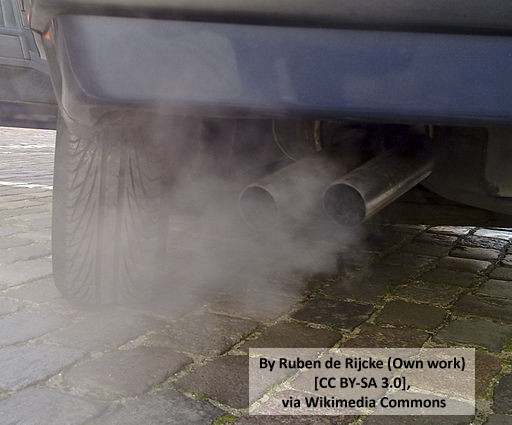
YouGov, whom I rather like, had a blog posting Londoners support a monthly car-free day Sadly, this comment did not get through their moderation.
(1) Cars kill the planet:
4 tonnes CO2 per year and 5 tonnes to make one. The UK Climate bill aims to get us to average 2 tonnes a year.
(2) Car filth kills:
Air pollution to blame for 60,000 early deaths per year, Government to be warned
(3) We need Green Ghettos with hardly any cars to save the world and avoid the filth. See The parable of the smoking carriages
Postscript: York polluted by traffic – This kills
York has a pleasant city centre but some of it badly polluted by traffic fumes and York Council has been accused of hiding the problem. Following a Freedom of Information request by former councillor Dave Merrett, York Press reported
[Dave Merrett] said the authority’s own air quality team said in an email to sustainable transport officers: “We not only need all six P&R routes to be fully electric, but most of the other regular bus routes as well, if we are to stand any chance of meeting the air quality objectives in the near future.”
York Press also reported an estimate of 100 deaths a year
An estimated 100 people a year die in York because of air pollution, and councillors and campaigners spoke this week about the damage that could be done if low emission buses are not brought in.
See also
Spin: UK footprint
Spin: UK footprint
Last week, The Telegraph reported Britain shows that world can cut carbon emissions and still get richer. They could not have expected the extra bonus of the cut back on jobs in steel production. Today, The Guardian comments As British steel industry goes into meltdown, government faces some burning questions.
As M Thatcher, who did care about the climate, once said “Rejoice, Rejoice!”. This will help us meet our climate committments and blame the Chinese. They will be making the steel to build our nice tall buildings in London to house the bankers.
For the boring technical stuff on carbon footprints see UK’s rising carbon footprint in “Greenwash from Stern?”
For the boring technical stuff on jobs and climate change see The job apocalypse and climate change.
One answer if anyone cares – Stop growth, redistribute wealth and try to save the planet.
 Don't look now
